Writing a Book Coached by AI: How it sharpened my writing and helped me sound more human
*** Ironically, I didn’t use any AI to write this article. ***
To use AI or not for writing my book?
I’ve been skeptical because I don’t want my book to scream “written by AI”. My tendency to write clinically makes it hard enough to sound human.
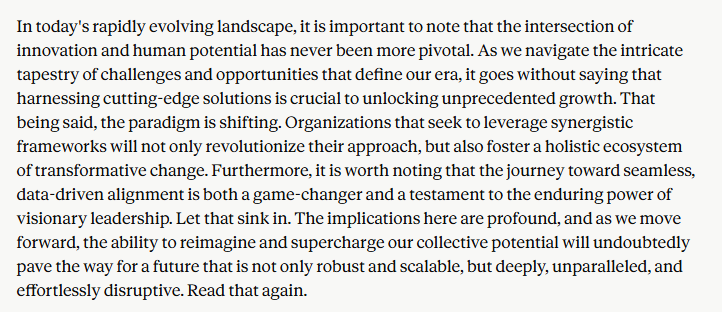
What I do NOT want my book to sound like
So I didn’t use AI at first.
When I asked feedback from others on the first part of my book, they pointed out overly complex phrases, redundancies, awkward choices of words, irrelevant pieces, and other flaws. I was a bit ashamed. Shouldn’t I be able to spot these issues on my own?
Around that time, I stumbled upon an article of Ruben Hassid including a long list of writing rules for AI to write text for you.
I decided to do an experiment.
Instead of using AI as my ghostwriter, I would use it as a writing coach.
My goals:
At the minimum, I wanted AI to flag bad formulations and teach me how to improve.
But perhaps it could also help me sound more human?
Here’s my approach. I warn you in advance: it takes a lot of time.
Step 1. Write the book
I wrote a first draft. Then I rewrote everything 3-4 times until I was satisfied.
I asked 7 people for feedback, and rewrote much of the book another 2-4 times.
The large number of iterations is normal. You need a rough sketch of the whole before you can see how to improve its structure. AI also can’t go from first draft to final version in one go without any thinking by the author. I did ask AI for feedback on the draft structure, argument, and content, but that is beyond the scope of this article.
Step 2. Improve clarity and simplicity
2a. Teach AI my desired writing style
I inserted my writing criteria in the general instructions of Claude, ChatGPT and CoPilot.
I based my criteria on the list I mentioned above. Simplified, the instructions come down to:
- Replace bloated words by simpler ones.
- Avoid meaningless filler words, phrases, and transitions.
- Avoid overly use of “not x but y” in all its forms.
- Avoid redundancy, wordy formulations, and content that seems less relevant.
Use these criteria as a guideline, not a rule. Discouraged formulations may still be used sparingly.
I update the criteria regularly, as I learn how AI interprets them.
2b. Submit the book for AI feedback
I used CoPilot because it is integrated directly into MS Word. In the meantime, Claude also works well with Word files and gives better results.
My exact prompt:
Review the provided document based on my Writing Criteria.
Cover all types of text: regular text, text in tables, boxes, frames, bullet points, and so on.
Cover each paragraph.
Add comments directly in the Word document using the comments function and track changes:
1/ In the comments: Your feedback and suggestions, briefly explained.
2/ In track changes: An alternative/extra phrase (or even full paragraph).
2c. Apply AI’s feedback paragraph by paragraph
This is the part that takes so much work if you want to do it right.
Most feedback was relevant. Despite my serious attempt at writing clear and concise English, I must admit that there was a lot of fluff to cut and buzz words to replace.
But I didn’t want to blindly accept any AI’s alternative formulation. Each phrase must be one that could have come from me.
While CoPilot pointed out the right issues, I didn’t always like its alternative. I often asked Claude for another formulation, and sometimes ChatGPT too.
Then I accepted one of the LLMs’ suggestions or wrote something entirely new, based on the alternatives.
In many cases, I re-submitted the paragraph to Claude to see if any further feedback came up.
Even after I had already done my best to be concise, AI helped me further reduce word length by 15% while improving the accuracy of my writing. That’s a lot of time saved for all the busy entrepreneurs and leaders who’ll hopefully read my book. 😊
(Read on below the photo.)
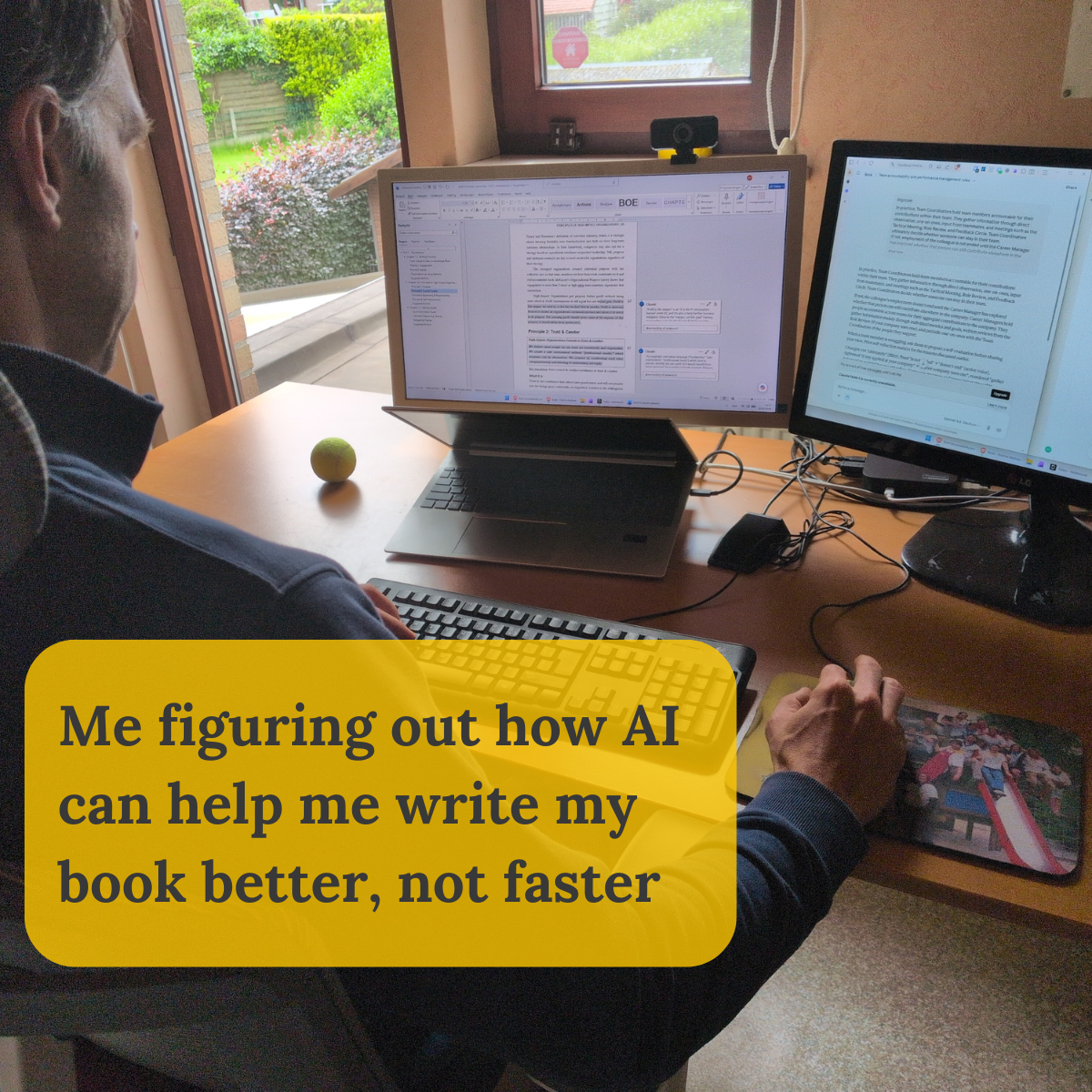
Step 3. Ask AI to help me write like a human
Despite the significant improvement in the quality of writing, I was worried that this process would dampen my authentic voice.
Already before using AI, my book's reviewers told me they missed emotional intensity and personal revelation in my stories.
Since I love experiments, I wanted to give AI a shot at helping me sound more human.
I applied a similar approach as in step 2.
3a. Figure out tips for sounding human
I didn’t have a list with tips yet but I asked Claude to come up with some. A few abbreviated examples:
- Tell stories. Own, direct experience first.
- Reveal your inner world, explaining how a situation makes you feel.
- Open sections with a direct, open question the reader can feel in their own experience.
- Name the pain plainly, with specifics, before naming the fix.
- Anchor every abstract claim in a named, real example within a paragraph or two.
- Take a position and let the evidence carry it, not the language.
Use these criteria as a guideline, not a rule. Follow the underlying idea rather than applying literally.
3b. Submit the book for AI feedback
My exact prompt:
Review the provided document based on my Human Writing Tips.
Cover all types of text: regular text, text in tables, boxes, frames, bullet points, and so on.
Provide at least [x] comments, but only if potential improvements are significant (otherwise, fewer comments are ok).
Add comments directly in the Word document using the comments function and track changes:
1/ In the comments: Your feedback and suggestions, briefly explained.
2/ In track changes: An alternative/extra phrase (or even full paragraph).
3c. Integrate AI’s feedback
This was less work than integrating AI’s editing suggestions in step 2 because obviously not every paragraph was affected. Still, whereas AI could offer concrete phrases in step 2, here I needed to come up with the content.
This last step was more insightful than I expected. It gave me tons of ideas for enriching my book with my personal experience and stories.
In conclusion
To be honest, I’m still not sure that this process doesn’t dampen my authentic voice. I’m aware that the small imperfections in my writing make the text mine.
Overall, I’m convinced it improved the book. My writing was too flawed to justify keeping it that way, especially for a book.
I also believe it helped me become a better writer. Rewriting hundreds of sentences based on feedback and alternative formulations of AI has made me revisit my existing writing habits. After a period of intensively using AI for feedback, I might not need it anymore.
Before my book goes to the printing press, I’ll probably hire a human editor. For now, AI is an easily accessible aid that may suffice for the digital pre-release.